De Klein K – A conversation with clay- 2021
A conversation with clay
De Klein K
Traduction Translation
🇫🇷
L’œuvre de Yoshimi Futamura
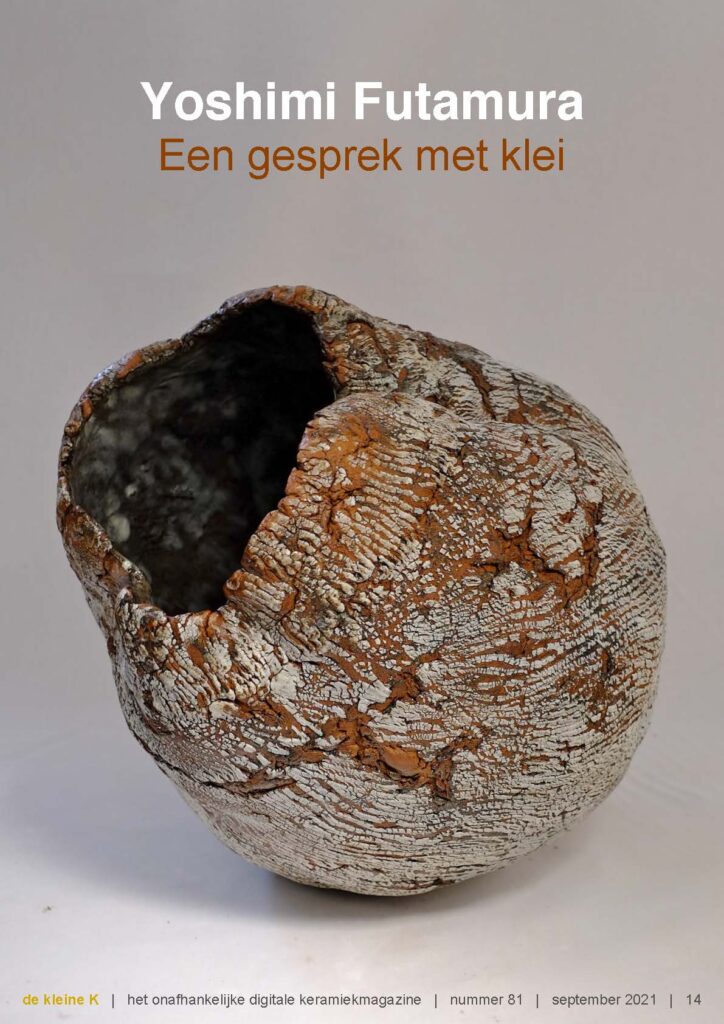
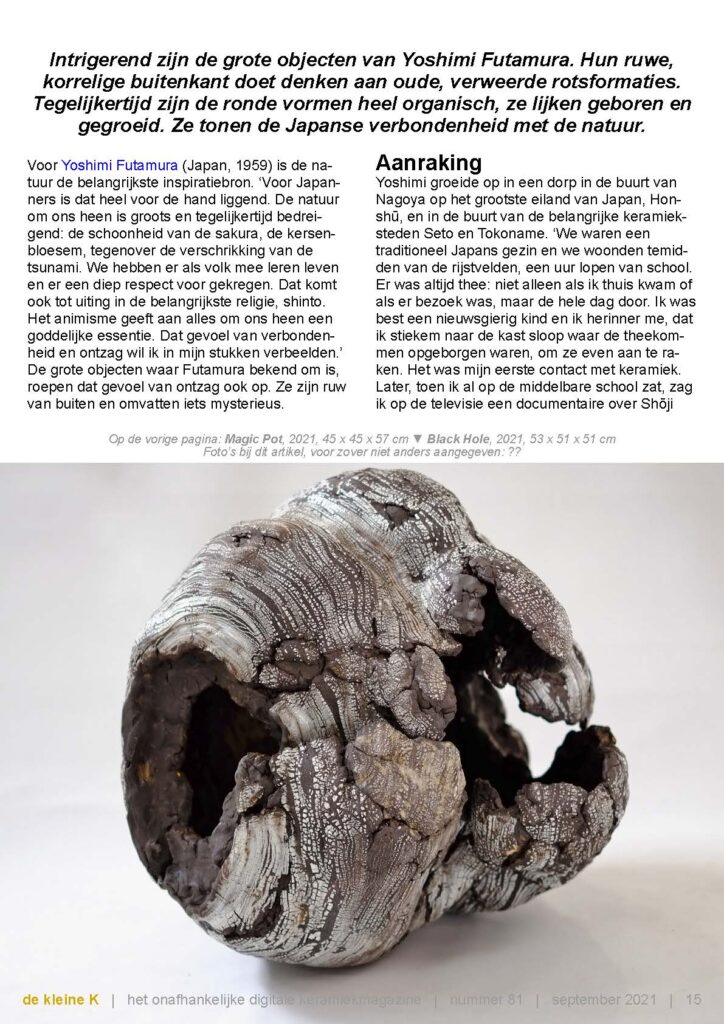
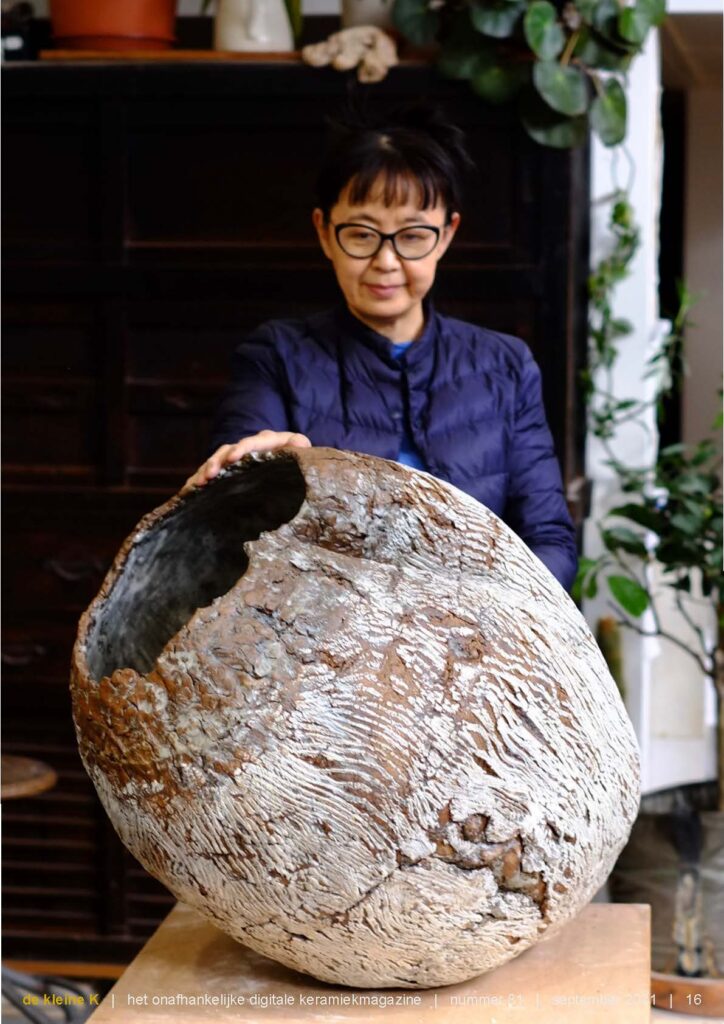
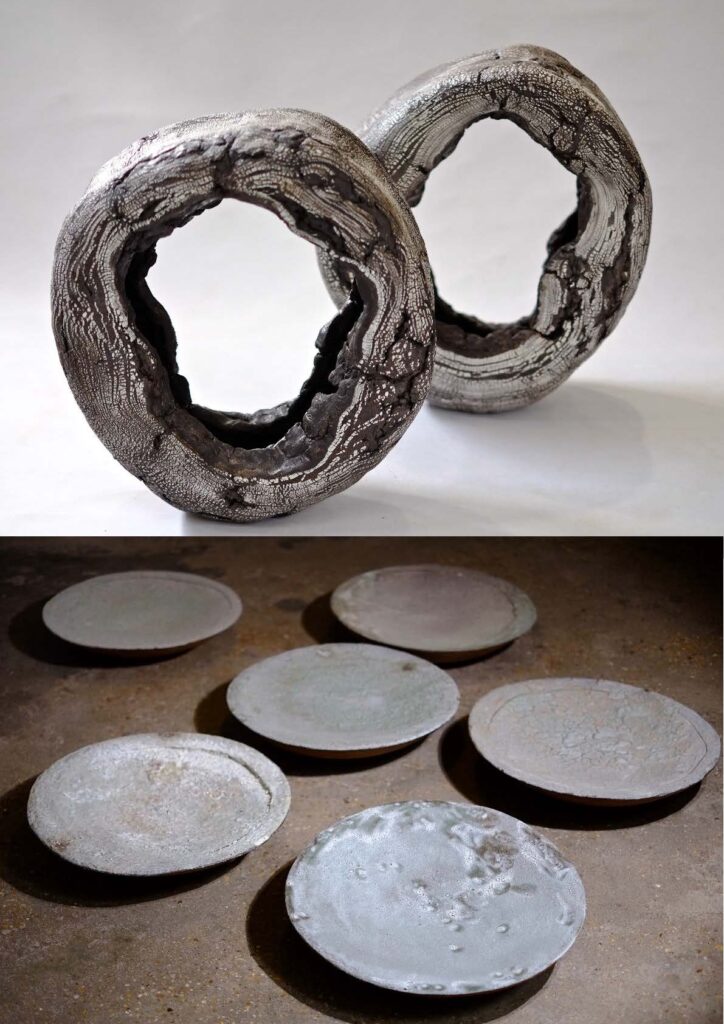
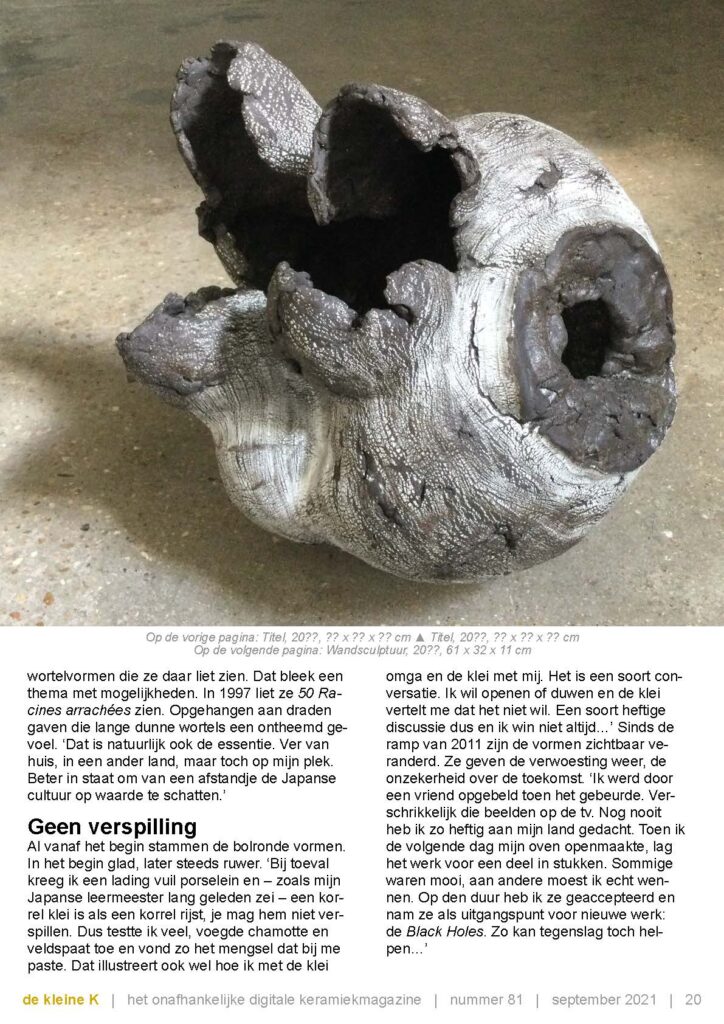
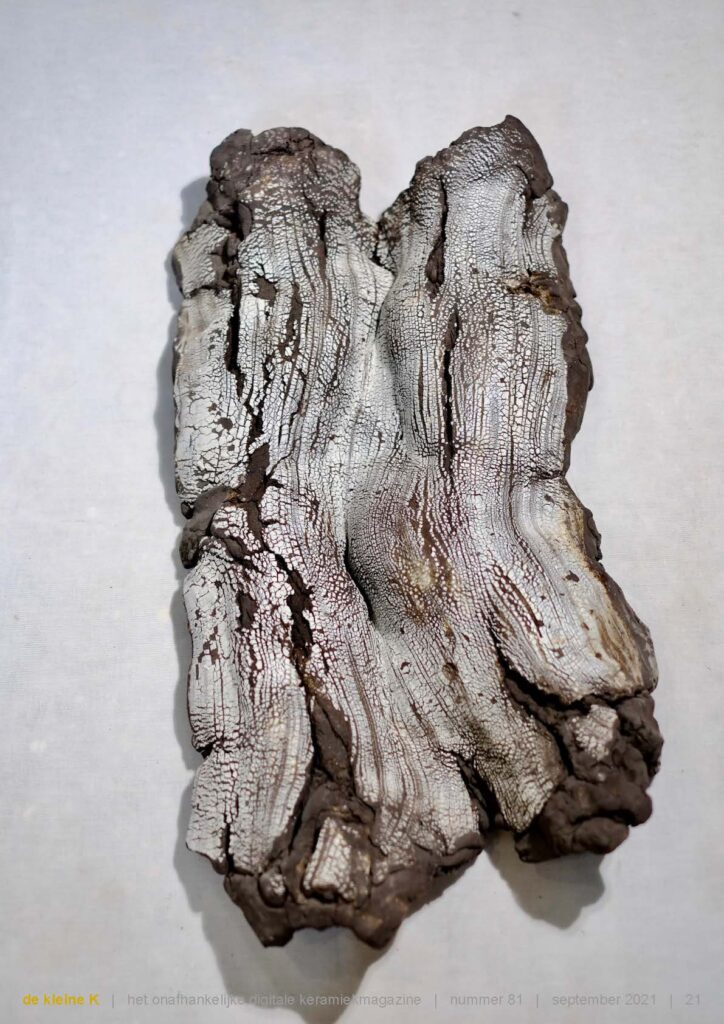
Les grandes pièces de Yoshimi Futamura sont intrigantes. Leur extérieur brut et granuleux rappelle d’anciennes formations rocheuses érodées. En même temps, leurs formes arrondies sont très organiques ; elles semblent être nées et avoir grandi d’elles-mêmes. Elles témoignent du lien profond des Japonais avec la nature.
Sources d’inspiration
Pour Yoshimi Futamura (Japon, 1959), la nature est la principale source d’inspiration. « Pour les Japonais, c’est une évidence. La nature qui nous entoure est à la fois grandiose et menaçante : la beauté du sakura (la fleur de cerisier) face à l’horreur du tsunami. En tant que peuple, nous avons appris à vivre avec elle et à développer un respect profond à son égard. Cela s’exprime également dans le shintoïsme, la religion la plus importante. L’animisme confère une essence divine à tout ce qui nous entoure. C’est ce sentiment de connexion et d’émerveillement que je veux représenter dans mes pièces. » Les grandes sculptures qui ont fait la renommée de Futamura évoquent ce sentiment de fascination. Elles sont brutes à l’extérieur et renferment quelque chose de mystérieux.
Le Contact
Yoshimi a grandi dans un village près de Nagoya, sur l’île principale du Japon, Honshū, à proximité des grandes cités de la céramique, Seto et Tokoname. « Nous étions une famille japonaise traditionnelle et nous vivions au milieu des rizières, à une heure de marche de l’école. Il y avait toujours du thé : pas seulement quand je rentrais à la maison ou quand nous avions des visites, mais tout au long de la journée. J’étais une enfant assez curieuse et je me souviens que je me glissais en cachette vers le placard où étaient rangés les bols à thé pour les toucher un instant. Ce fut mon premier contact avec la céramique. » Plus tard, alors qu’elle était au lycée, elle vit à la télévision un documentaire sur Shōji Hamada. Le voir travailler dans son atelier fut un enchantement : « Je me suis immédiatement dit : on peut donc en faire son métier, c’est ce que je veux faire ! » Bien que sa famille soit peu enthousiaste, elle part étudier la céramique à Seto, faisant chaque jour deux heures de trajet. À cette époque, l’artisanat de la céramique connaissait un renouveau et l’école de Seto était très prisée, même par les étrangers. Elle y resta trois ans, puis travailla sept ans dans une usine de céramique traditionnelle, élargissant ses connaissances en visitant de nombreuses expositions.
Racines
Vers 1986, Futamura décide de suivre sa propre voie. Elle prend une année sabbatique et part au Sri Lanka avec une organisation bénévole. « Un monde s’est ouvert à moi et j’ai réalisé que je pouvais trouver ma place n’importe où dans le monde. » Cela se confirma lorsqu’elle partit pour Paris. Bien qu’elle ne parlât pas la langue, elle s’adapta rapidement. Elle fut la première Japonaise à étudier à l’École Supérieure des Arts Appliqués Duperré (1989-1994). « Les étudiants venaient du monde entier et je m’y sentais chez moi. L’art et la culture japonaise étaient alors très populaires à Paris, avec de nombreuses expositions consacrées à l’artisanat. »
Le moment vint de créer ses propres œuvres. Yoshimi reçut des propositions pour exposer dans des galeries parisiennes. Les marchés de potiers, comme au Japon, étaient encore rares. Dès le début, la nature fut son inspiration : ses expositions s’intitulaient Vagues de terre et Sous la terre. Cette dernière faisait référence aux premières formes de racines qu’elle y présentait. Ce thème s’avéra riche en possibilités. En 1997, elle expose 50 Racines arrachées. Suspendues à des fils, ces racines longues et fines dégageaient un sentiment de déracinement. « C’est bien sûr l’essentiel. Loin de chez soi, dans un autre pays, mais pourtant à sa place. Cela permet de mieux apprécier la culture japonaise avec un certain recul. »
Pas de gaspillage
Dès ses débuts, elle privilégie les formes sphériques. D’abord lisses, elles devinrent de plus en plus rugueuses. « Par hasard, j’ai reçu une cargaison de porcelaine “sale” et — comme mon maître japonais me l’avait dit il y a longtemps — un grain d’argile est comme un grain de riz : on ne doit pas le gaspiller. J’ai donc fait beaucoup de tests, ajouté de la chamotte et du feldspath, et j’ai fini par trouver le mélange qui me correspondait. Cela illustre bien ma façon de dialoguer avec l’argile. Je veux ouvrir ou pousser, et l’argile me dit qu’elle ne veut pas. C’est une sorte de discussion intense et je ne gagne pas toujours… »
Depuis la catastrophe de 2011, ses formes ont visiblement changé. Elles reflètent la dévastation et l’incertitude quant à l’avenir. « Un ami m’a appelée quand c’est arrivé. Ces images à la télé étaient terribles. Je n’avais jamais pensé aussi intensément à mon pays. Le lendemain, quand j’ai ouvert mon four, une partie de mon travail était en morceaux. Certaines pièces étaient belles, d’autres ont nécessité un temps d’adaptation. Finalement, je les ai acceptées et je les ai utilisées comme point de départ pour de nouvelles œuvres : les Black Holes (Trous noirs). C’est ainsi que l’adversité peut finir par aider… »
🇺🇸
The Work of Yoshimi Futamura
The large objects created by Yoshimi Futamura are intriguing. Their rough, grainy exterior is reminiscent of ancient, weathered rock formations. At the same time, the rounded shapes are very organic; they appear to have been born and grown naturally. They demonstrate the Japanese connection with nature.
Sources of Inspiration
For Yoshimi Futamura (Japan, 1959), nature is the primary source of inspiration. “For Japanese people, this is very obvious. The nature around us is both grand and threatening: the beauty of the sakura (cherry blossom) versus the horror of the tsunami. As a people, we have learned to live with it and have developed a deep respect for it. This is also expressed in the primary religion, Shinto. Animism gives everything around us a divine essence. I want to represent that feeling of connection and awe in my pieces.” The large objects for which Futamura is known evoke that same sense of wonder. They are rough on the outside and encompass something mysterious.
Touch
Yoshimi grew up in a village near Nagoya on Japan’s largest island, Honshū, and near the major ceramic cities of Seto and Tokoname. “We were a traditional Japanese family and we lived in the middle of the rice fields, an hour’s walk from school. There was always tea: not just when I came home or when there were visitors, but throughout the day. I was quite a curious child and I remember sneaking to the cupboard where the teabowls were stored just to touch them for a moment. It was my first contact with ceramics.” Later, when she was already in high school, she saw a documentary on television about Shōji Hamada. Watching him work in his studio was enchanting: “I immediately thought: so you can make a profession out of this, that’s what I want too!” Although her family was less enthusiastic, she went to study ceramics in Seto, traveling two hours back and forth every day. At that time, there was a major revival of the ceramic craft, and the school in Seto was very popular, even among foreigners. She stayed there for three years and then went to work in a factory making traditional ceramics for seven years, broadening her knowledge by visiting many exhibitions.
Roots
Around 1986, Futamura felt it was time to find her own path. She took a year off and went to Sri Lanka with a volunteer organization. “A world opened up for me and I realized that I could find my place anywhere in the world.” This proved true when she went to Paris. She didn’t speak the language but was able to adapt quickly. She was the first Japanese woman to study at the École Supérieure des Arts Appliqués Duperré (1989-1994). “The students came from all over the world and I felt at home there. Japanese art and culture were very popular in Paris at the time, with many exhibitions focused on crafts.”
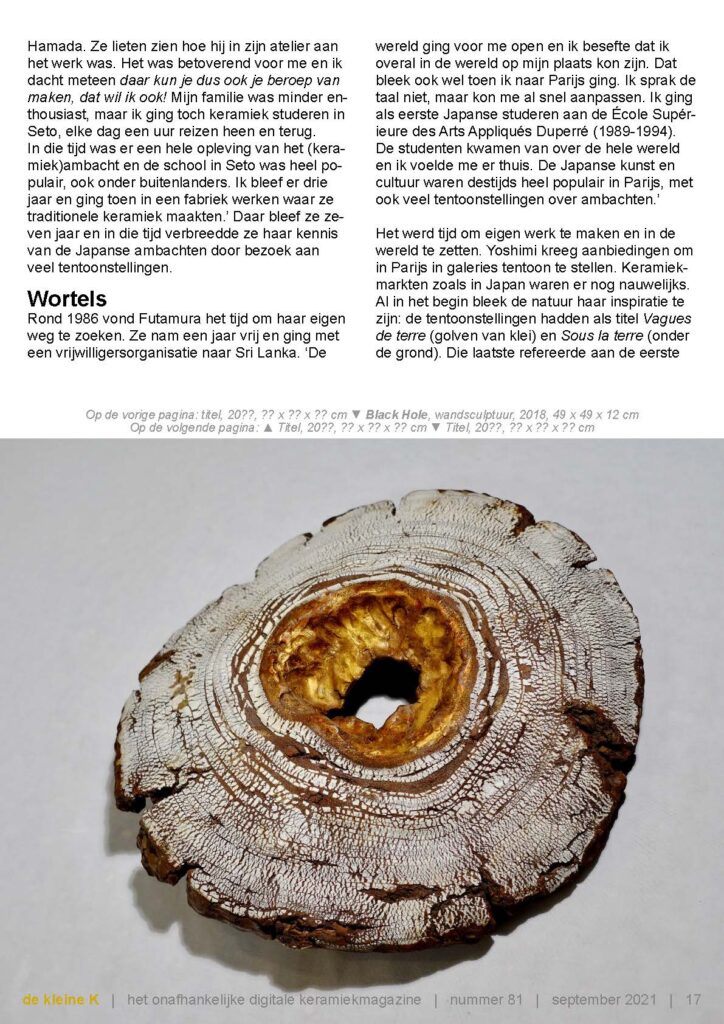
It became time to create her own work. Yoshimi received offers to exhibit in Parisian galleries. Ceramic markets like those in Japan hardly existed there yet. From the beginning, nature proved to be her inspiration: her exhibitions were titled Vagues de terre (Waves of Earth) and Sous la terre (Under the Ground). The latter referred to the first root forms she displayed there. This turned out to be a theme full of possibilities. In 1997, she showed 50 Racines arrachées (50 Uprooted Roots). Hanging from threads, those long thin roots gave a sense of displacement. “That is the essence, of course. Far from home, in another country, yet in my place. It makes me better able to appreciate Japanese culture from a distance.”
No Waste
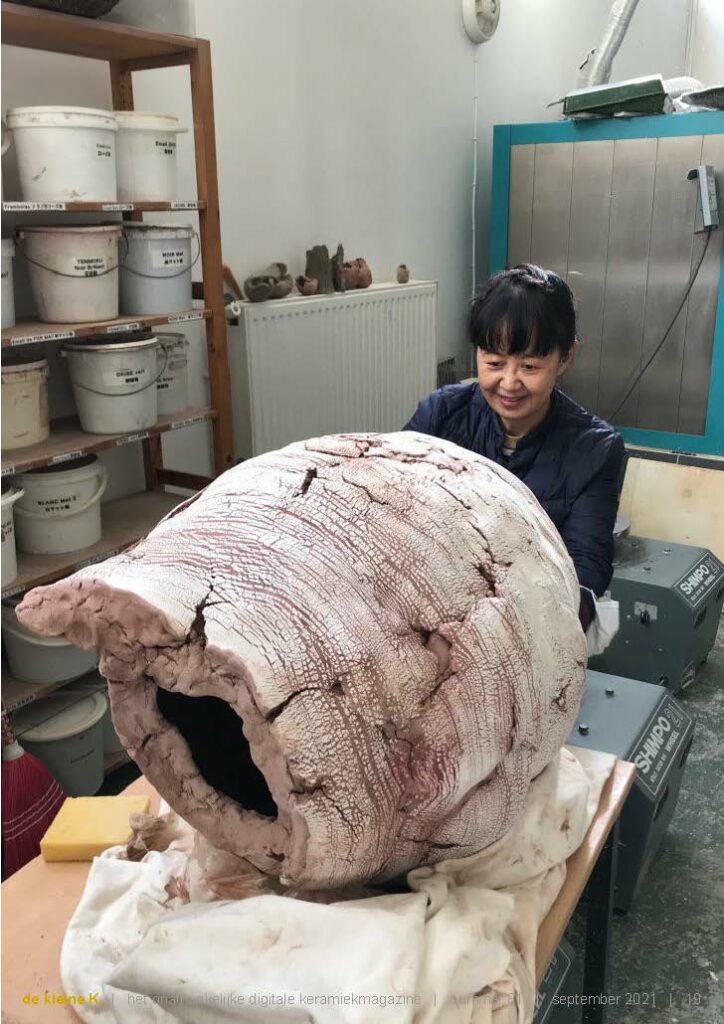
From the very beginning, the spherical shapes emerged. Smooth at first, then increasingly rough. “By chance, I received a load of ‘dirty’ porcelain and—as my Japanese master said long ago—a grain of clay is like a grain of rice, you must not waste it. So I tested a lot, added chamotte and feldspar, and found the mixture that suited me. That also illustrates how I interact with the clay and the clay with me. It is a kind of conversation. I want to open or push, and the clay tells me it doesn’t want to. A sort of heated discussion, and I don’t always win…”
Since the disaster of 2011, the forms have visibly changed. They reflect the devastation and the uncertainty about the future. “I was called by a friend when it happened. Terrible, those images on TV. I have never thought so intensely about my country. When I opened my kiln the next day, part of the work was in pieces. Some were beautiful, others I really had to get used to. Eventually, I accepted them and took them as a starting point for new work: the Black Holes. That’s how adversity can actually help…”